
Stop logging into Salesforce.

In an AI-shaped workplace, what is the role of software platforms in the operating model, and how do the human roles around them need to change?
A week ago I shared six open questions that I’m wrestling with around AI and work. This piece is me trying to put some flesh on that first one.
Basically, how is software changing, and what does that mean for the people who use it?
Not long ago I was sitting across the table from Steve.
Steve is a very good sales rep.
He builds rapport instantly. He remembers details and solves problems, and he’s trusted by all his clients.
For years, Steve has grown his accounts and found new work and has been one of his company’s top performers. He’s enjoying (well, he was) the twilight years of his sales career – still a few years from retirement with lots of energy to keep hunting and selling.
But then, Steve’s company implemented a new CRM.
It’s exactly what they need. It’ll help managers see their pipeline, give the business clarity, and help the company scale. The roll-out has gone really well.
Steve struggled.
I’m going over it again with him here at his desk. He’s hovering slowly over his iPad with one index finger, and then studiously writing down each step I take him through in his paper diary. He’s visibly frustrated. I get it. He’s frustrated because he’s brilliant at his job. He sells millions of dollars of stock each month, but he is being made to do a task in software that doesn’t come naturally to him at all. He makes a sarcastic joke about IT ‘forcing this down our throats’ and then tries to distract me with an anecdote.
Software isn’t Steve’s thing.
Steve isn’t unusual. Sometimes the people who are best at the work are the ones struggling with the software we put around it.
Selling has become selling plus updating records.
Managing accounts has become managing accounts plus navigating reports.
Serving customers has become serving customers plus knowing which field, tab, filter, custom object needs to be updated to close the case.
For years I've said that I "work in tech".
Really, like most people in my industry, I actually "work in Software".
I help organisations implement software, help users get value from software, work alongside product owners and admins who have built their careers on pieces of software. I'm in a Software ecosystem. I partner with a Software company. I go to software conferences, sorry… world tours.
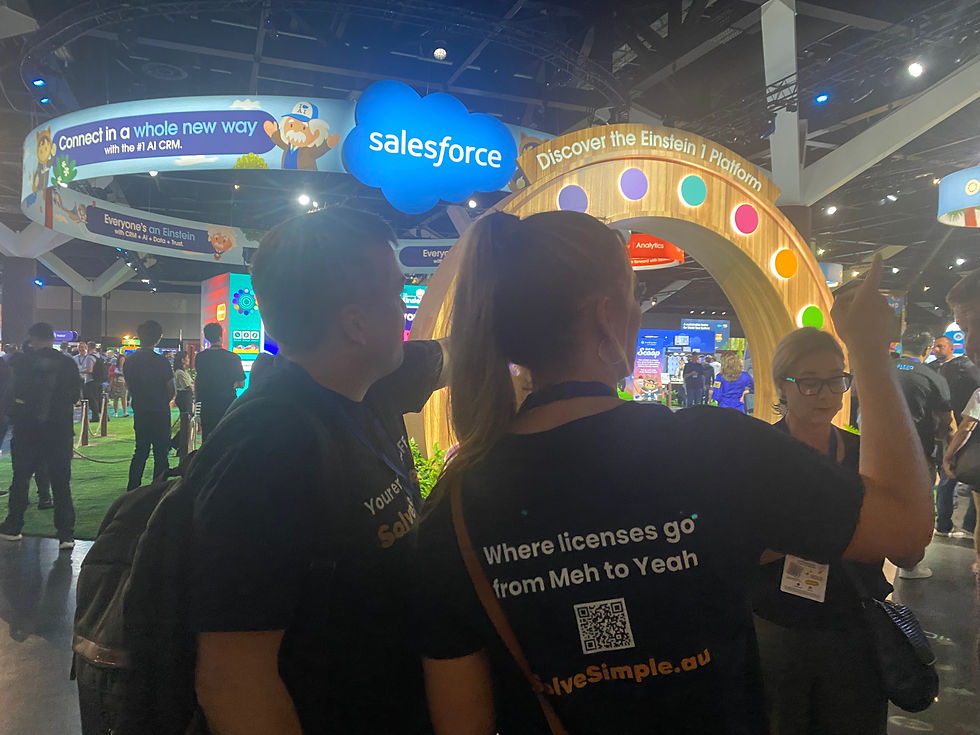
The whole time I’ve been in “Software World” (lamest theme park ever), the aim of the game has been pretty clear: Sell licenses, implement the solution, get people trained.
Not just that. Do everything you can, from fun branding, to experiences, to exciting adventurous language (I see you trailblazer), to get people onto the software. That’s why I’m here listening to Steve complain about IT.
I’m playing the game.
But the game is changing.
A couple of weeks ago Salesforce announced Headless 360.
Basically, Salesforce for agents before humans.
Everything exposed for an agent to use without needing all the extra work of a UI (The U being a bit of the problem).
The quote from Salesforce Co-Founder, Parker Harris was: “Why should you ever log into Salesforce again?”
I don’t know what hits you when you read that question.
For me, it’s a mix.
I think of Steve. For so long we’ve been turning workers into skilled software users. Many of them have found that transition difficult. They have the skills to do the most critical part of their job: build relationships, solve problems, find solutions - and yet “Software World” has put more tasks in their way like ‘negotiate a spreadsheet’, ‘build reports’, learn where to go to show all activities that are older than 2 months (IYKYK).
If the world has changed and now conversation becomes the interface as humans ask agents to do all the Software-ing for them, suddenly Steve has a new horizon.
He still needs to learn. But he’ll be learning how to ask good questions. He’ll be learning how to find the right answers in his data, without having to fiddle around with filters and row limits. I think Steve will do well.
But it’s not just Steve.
What about the software trainer sitting across from him?
Where do I fit?
What does “enablement” look like in a world without a UI to train on? It’s definitely not point-and-click training or user guides. I think it’s more like question framing. I think it’s reimagining operating models for teams. I think it’s coaching workers to be better managers of their agentic colleagues.
And what is the role of the software itself? It moves from being a destination that we want users to go to, and becomes more of an infrastructure layer. It sits in the background and connects the data into meaningful insights for the users so that they can spend more time on the work that matters.
Teams that have drifted to organise themselves around software tasks, can start coming back to the purpose of their role (eg. Selling, serving, accounts receivable-ing) instead of breaking it down into clicks and screens.
One direct change (that’s probably been coming for a while) is the shift in the role of the Admin/Platform Owner. These are roles that have grown up in Software World. For them, it’s going to be learning to think more like architects and less like help-desk agents.
Admins won’t just be sitting deep in IT teams anymore, sorting through feature requests and page layouts. They’ll need to be concerned with governance and data quality, and where the guardrails are.
Software World isn’t closing down. But it’s going to go through a vibe shift.
For so long Software World has looked like bright colours, plushy mascots, showbags, live bands and Matthew McConaughey. But in a world where Software is no longer the destination, where “Why should you ever log into Salesforce again?” is the question, does it really need to feel so fun? One thing I know about Software World, we probably don’t need Steve to go.
This is just one corner of the bigger question that I’m still chewing on. With software moving to the background it might mean hope for the Steves of the world. For the first time in a long time, change is for them, not against them.
For the rest of us who have spent our careers in Software World racking up trailblazer badges and Astro swag, it might be time to rethink what we’re selling, how and what we’re training, and where we fit.
Someone should tell Matthew McConaughey.
Written by Dan Godden, Founder & Principal Solve Simple


Comments